For many non-Muslim families living in the UAE, one of the first questions in a family dispute is not simply: What does UAE law say?
It is: Which UAE family-law framework applies to us?
That distinction matters.
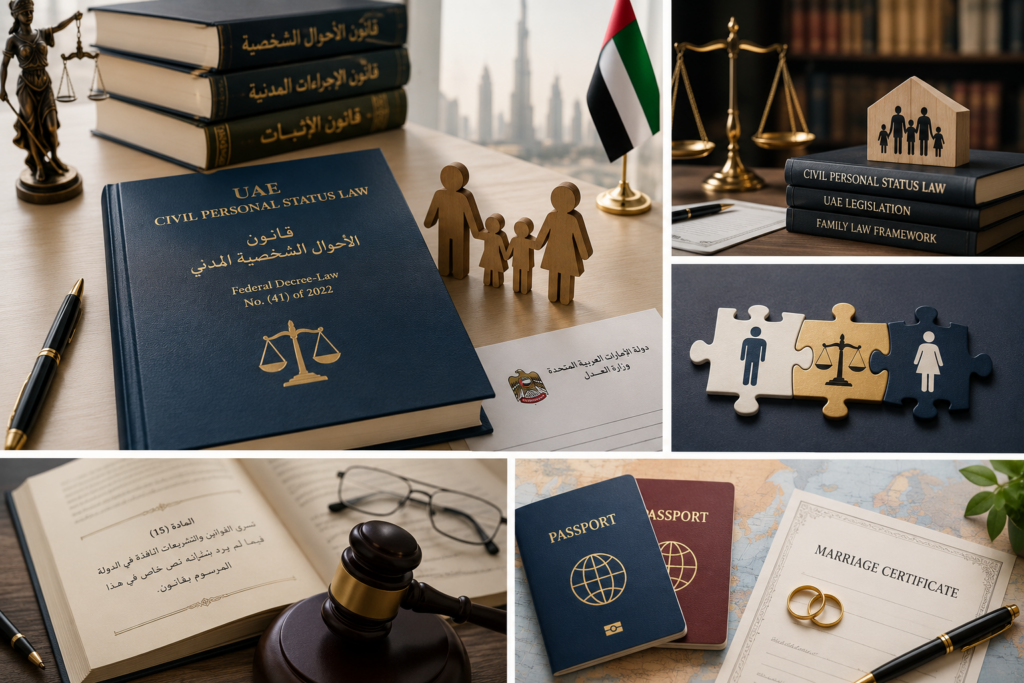
The UAE has a specific Civil Personal Status Law designed for non-Muslims within its scope. It introduced a legal framework that looks different in several important ways from the general personal-status system that traditionally governs Muslim family matters.
The differences are not only technical.
They reflect a different legal approach to marriage, divorce, custody and financial rights.
And just as importantly, the Civil Personal Status Law does not operate in complete isolation from the rest of UAE legislation.
That is where Article 15 becomes especially important.
Who Does the Civil Personal Status Law Apply To?
Federal Decree-Law No. 41 of 2022 applies to non-Muslim UAE citizens and to non-Muslim foreigners residing in the UAE, subject to the rules stated in the law.
The law also allows those within its scope, in certain circumstances, to agree on the application of other family or personal-status legislation in force in the UAE instead.
That flexibility is one of the features that distinguishes the regime.
So the first question is not always simply whether a family is non-Muslim.
It may also be necessary to ask whether another legally available family-law framework has been chosen or invoked.
A Different Legal Philosophy
One of the clearest features of the Civil Personal Status Law is its emphasis on equality between men and women in the rights and obligations regulated by it.
The law expressly addresses equality in matters such as testimony, inheritance, the right to request divorce and joint custody.
That immediately gives the regime a different structure from the traditional model that many expatriates may expect when they first hear the words “personal status law”.
The purpose is not to remove all legal complexity.
It is to create a civil family-law framework that reflects the circumstances of the people it is designed to govern.
Civil Marriage
The law recognises civil marriage and provides a framework for its conclusion and certification.
It sets conditions relating to age, consent, prohibited degrees of relationship and disclosure of previous marriages.
The marriage contract may also include agreed terms governing rights during the marriage and after divorce, including matters connected with joint custody.
This contractual element is important.
It means the parties may have greater scope to define parts of their legal relationship in advance, within the limits permitted by law.
Divorce Without Proving Fault
One of the most distinctive features of the regime is the possibility of unilateral divorce without the need to prove harm or assign blame to the other spouse.
Either spouse may express the wish to separate and end the marriage.
The divorce is then issued by court judgment after the other party has been notified.
This can make the legal route to ending the marriage more direct.
But a simpler route to divorce does not necessarily mean that every consequence of divorce is simple.
The financial position after divorce can still require careful analysis.
Financial Rights After Divorce
The Civil Personal Status Law gives the divorced wife the possibility of applying for financial support after the divorce order, where the relevant rights have not already been regulated by agreement in the marriage contract.
The court may consider several factors, including:
the length of the marriage;
the age of the wife;
the financial circumstances of both spouses;
the extent to which the husband contributed to the divorce by neglect, fault or conduct;
material or moral harm caused by the divorce;
financial damage resulting from unilateral divorce;
and other factors connected with the care of the children and the circumstances of the family.
So while the marriage may be ended without proving fault, fault and harm can still become relevant when the financial consequences are assessed.
That is an important distinction.
Joint Custody as the Starting Point
Another major feature is joint custody.
The law treats custody after divorce as a joint and equal right of both parents, subject to the child’s interests and to the circumstances that may justify a different arrangement.
Either parent may ask the court to intervene where joint custody becomes disputed or impractical.
The court retains discretion to decide what best serves the child.
So joint custody is the starting point.
It is not an absolute rule that ignores the realities of the family.
Inheritance and Wills
The law also includes its own rules on estates and wills.
It allows a person within its scope to make a will in relation to assets in the UAE, subject to the applicable rules.
Where there is no will, the law provides a civil distribution model that differs from the traditional inheritance rules applied in Muslim personal-status matters.
The surviving spouse and children are treated under the framework set out in the law, including equal distribution among children without distinction between male and female.
This is another area where understanding which legal regime applies can make a substantial difference.
What Happens When the Law Does Not Answer the Question?
This is one of the most important provisions in the entire law.
Article 15 states that: the laws and legislation in force in the UAE govern matters not specifically addressed in the Civil Personal Status Law.
That means the Civil Personal Status Law is a specialised framework.
But it is not a closed legal system.
If the law does not regulate a particular issue, the answer is not necessarily:
“There is no rule.”
Instead, the court may need to look to other UAE legislation that governs the matter.
This is important because the Civil Personal Status Law is relatively concise.
A family dispute may raise questions about evidence, procedure, enforcement, property, capacity, court powers or other matters that are not fully contained within its Articles.
Article 15 creates the bridge between this specialised regime and the wider UAE legal system.
Does That Mean Muslim Personal Status Law Automatically Applies?
Not automatically.
Article 15 does not say that every gap in the Civil Personal Status Law must simply be filled by the general personal-status law.
Its wording is broader.
It refers to the laws and legislation in force in the UAE.
Which legislation is relevant depends on the issue that needs to be resolved.
That distinction matters.
A question about evidence may lead to one law.
A procedural question may lead to another.
A family-law issue may require consideration of another personal-status rule where legally relevant.
The correct answer depends on the nature of the gap.
A Special Regime, Not an Isolated One
The Civil Personal Status Law created an important and distinct family-law framework for non-Muslims in the UAE.
It introduced civil marriage.
No-fault-style divorce.
A different approach to post-divorce financial rights.
Joint custody as a starting point.
And its own rules on inheritance and affiliation.
But understanding the law requires more than reading its headline provisions.
It also requires understanding how it interacts with the rest of UAE legislation.
At My Family Lawyer, we look not only at whether the Civil Personal Status Law applies.
We also look at what it regulates, what it leaves open, whether another family-law framework may be available, and which UAE laws may become relevant where the Civil Personal Status Law itself is silent.
Because knowing the name of the law is only the first step.
The more important question is how the legal framework actually works in your particular case.